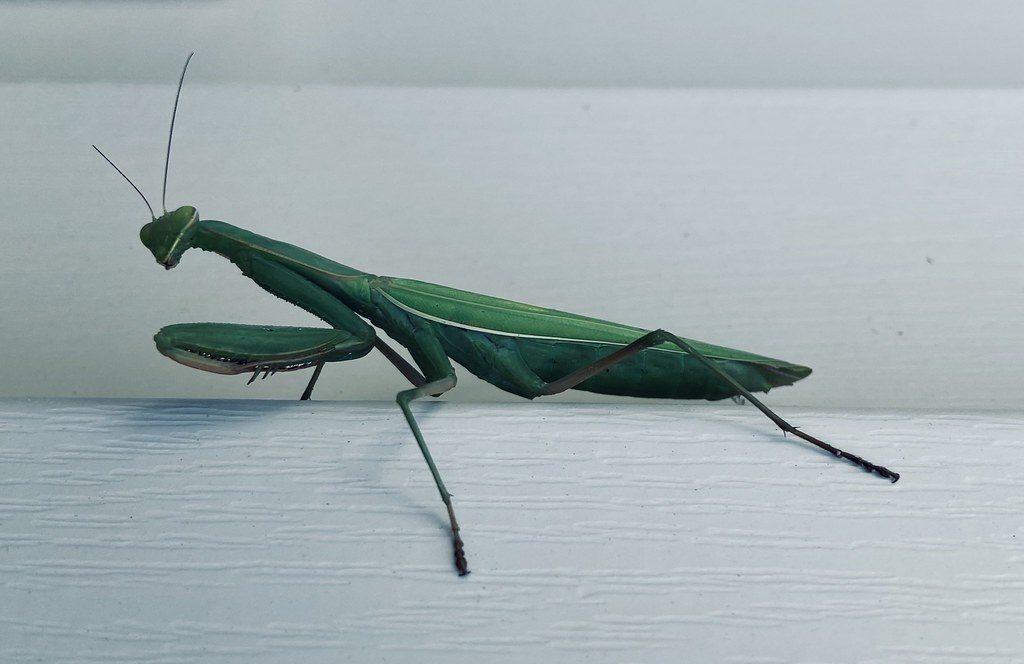
Praying mantises eat live insects, and almost any insect they can catch. In the wild that means flies, crickets, moths, grasshoppers, caterpillars, bees and even other mantises. A pet mantis does well on fruit flies while it is tiny, then houseflies, small crickets and other live insects about its own size as it grows.

What Praying Mantises Eat in the Wild
Every mantis is a predator. University of Wisconsin horticulture specialists describe them as feeding on “virtually anything they can catch,” and the lists from extension services in Kentucky, North Carolina, Colorado, Texas and Missouri all look much the same:
- Flies, gnats and midges
- Crickets and grasshoppers
- Moths, butterflies and caterpillars
- Bees and wasps
- Leafhoppers and aphids (mostly eaten by young mantises)
- Cockroaches and spiders
- Other mantises, including their own siblings
Mantises are ambush hunters. They sit still on plants, often near flowers where insects visit, or creep toward prey very slowly. When something moves within reach, the spiny front legs snap shut and hold it while the mantis eats. Colorado State University Extension sums up their menu as “essentially any moving insect of the right size.”
Do praying mantises eat hummingbirds?
Sometimes, but it is rare. The Missouri Department of Conservation says female Chinese mantises have occasionally been recorded eating small reptiles, amphibians and hummingbirds. Texas A&M AgriLife notes the larger non-native species can take hummingbirds, lizards and even small mammals. If you see a big mantis waiting on a hummingbird feeder, the Texas A&M advice is simply to move it somewhere else.
What baby mantises eat
Newly hatched nymphs are tiny, so they hunt tiny prey: aphids, gnats, fruit flies and leafhoppers. University of Kentucky entomologists note that the first meal is often a sibling, because hatchlings will eat each other when food is scarce.
What to Feed a Pet Praying Mantis
A pet mantis needs live food. It hunts by movement, so it generally ignores anything that doesn’t move. The basic rule from the University of Kentucky is to offer insects about the mantis’s own size or smaller, and to move up to bigger prey as it grows. The Amateur Entomologists’ Society adds that some species will tackle prey as large as themselves, but smaller is the safer starting point.
Feeding chart by growth stage
| Stage | Good foods | Notes |
|---|---|---|
| Newly hatched nymphs | Fruit flies (Drosophila), aphids, gnats, leafhoppers | Food must be very small. Keep plenty available so nymphs don’t eat each other. |
| Young nymphs (after a few molts) | Fruit flies, pinhead and small crickets, small flies, midges | Colorado State suggests small flies attracted to a porch light as an easy free option. |
| Larger nymphs | Houseflies, small crickets, small grasshoppers, leafhoppers | Stay at about the mantis’s own size or smaller. |
| Adults | Crickets, grasshoppers, blue bottle flies, moths, cockroaches | Larger species can take bigger prey. Remove anything uneaten. |
If you already keep feeder insects for other pets, the same fruit fly cultures and small crickets work. Our guides to what pet spiders eat and what to feed tiny spiders cover the same feeder insects in more detail.
How often to feed a praying mantis
The sources agree on the general idea more than on a fixed schedule. NC State Extension says mantises in captivity need to be fed frequently. The Amateur Entomologists’ Society suggests giving young mantises as much food as they can eat, while noting they can last quite a while without food. A practical approach:
- Nymphs: keep small prey available most of the time, especially if more than one nymph shares a container.
- Adults: offer an insect or two, watch whether the mantis eats, and offer more when it is actively hunting again.
- Around a molt: take live insects out while a mantis is hanging to shed its skin. It is soft and can’t defend itself until the new skin hardens.
Let the mantis’s appetite guide you. If it strikes at prey right away, it is ready to eat. If it ignores food, take the insect out and try again later.
Water and humidity
Mantises drink droplets rather than from a dish. The Amateur Entomologists’ Society recommends lightly spraying the enclosure with clean water once a day, which also raises humidity for molting. Colorado State’s rearing advice is lighter, about once a week, so the right amount depends on the species and how dry your home is. Use a fine mist; small nymphs can get trapped and drown in big drops.
What Not to Feed a Mantis (and Feeding Mistakes)
- Dead insects or fruit. Most mantises only strike at moving prey and will leave these to rot.
- Prey that’s too big. An oversized cricket or grasshopper can fight back and injure a small mantis.
- Live food left in the cage. The Amateur Entomologists’ Society warns that uneaten crickets, grasshoppers and cockroaches can chew a mantis’s legs or wings. Remove leftovers.
- Insects near a molting mantis. A mantis hanging still to shed its skin can’t defend itself.
- Two mantises in one container. They will eat each other. The Society suggests housing nymphs separately after the second or third molt, and Colorado State recommends separate containers from the start.
Molting also needs room. Give a stick or branch to hang from, with the distance from its top to the floor at least four times the mantis’s length, according to the Amateur Entomologists’ Society. A cramped or very dry cage can lead to a failed molt.
Are Praying Mantises Good for Pest Control?
Not very. Extension entomologists in Wisconsin, Kentucky, Colorado and Missouri all make the same point: mantises eat whatever they can catch, including bees, butterflies and other predators of garden pests. Kentucky rates their pest-control value as small compared with lady beetles and green lacewings, and Colorado notes that most of what they catch are flies, gnats and bees that don’t harm plants.
The mantis egg cases sold for gardens are usually the Chinese mantis, which is not native to the U.S. The Missouri Department of Conservation calls releasing it “ill-advised,” since it eats smaller native mantises and may be contributing to the decline of the native Carolina mantis. If you want mantises around, cutting back on broad-spectrum insecticides and leaving some dense plants for cover does more than buying egg cases.
Mantises are food for other animals, too. Birds, bats, spiders, lizards and other reptiles eat them, as extension fact sheets from Wisconsin, North Carolina and Texas point out. Our post on whether snakes eat grasshoppers covers the insect-eating snakes that share their habitat.
Bottom Line
Praying mantises eat live insects of a size they can grab: flies, crickets, moths, grasshoppers, caterpillars, bees and other mantises. For a pet, start nymphs on fruit flies and aphids, move up to houseflies and small crickets as they grow, and give adults crickets, grasshoppers and moths. Keep prey no bigger than the mantis, take out anything uneaten, mist lightly for water, and house each mantis on its own.
FAQ
Can a praying mantis eat dead insects?
Usually not. Mantises hunt by sight and strike at movement, so dead food tends to be ignored. The Amateur Entomologists’ Society notes one African species will take bits of raw meat offered on tweezers, but live insects are the normal diet.
How long can a praying mantis go without food?
The Amateur Entomologists’ Society says mantises can last quite a while without food. There is no set number of days, so don’t test it on purpose. Keep offering live prey, and if a mantis refuses food for a long time and looks thin, it may be sick or near the end of its natural lifespan.
Do praying mantises drink water?
Yes. They drink droplets from leaves and enclosure walls, which is why keepers mist the cage instead of putting in a water dish.
How long do praying mantises live?
Most live about a year, according to the Missouri Department of Conservation. In much of the U.S. they hatch in spring, lay eggs in late summer or fall, and die with the first hard freeze. Some pet species live 12 to 18 months, the Amateur Entomologists’ Society says.
Should I bring a mantis egg case inside for the winter?
No. NC State and Colorado State both say indoor warmth makes the eggs hatch early, when there is no food outside, and the nymphs then eat each other. Keep egg cases somewhere cold, like an unheated shed, or refrigerated until spring.
Sources
- University of Wisconsin-Madison Extension: Praying Mantids
- University of Kentucky Entomology: Praying Mantids (ENTFACT-418)
- NC State Extension: Chinese Praying Mantid
- Colorado State University Extension: Mantids of Colorado
- Texas A&M AgriLife Today: Praying Mantid Facts, Friend or Foe in the Garden?
- Missouri Department of Conservation: Mantids (Mantises)
- Amateur Entomologists’ Society: Praying Mantid Care Sheet