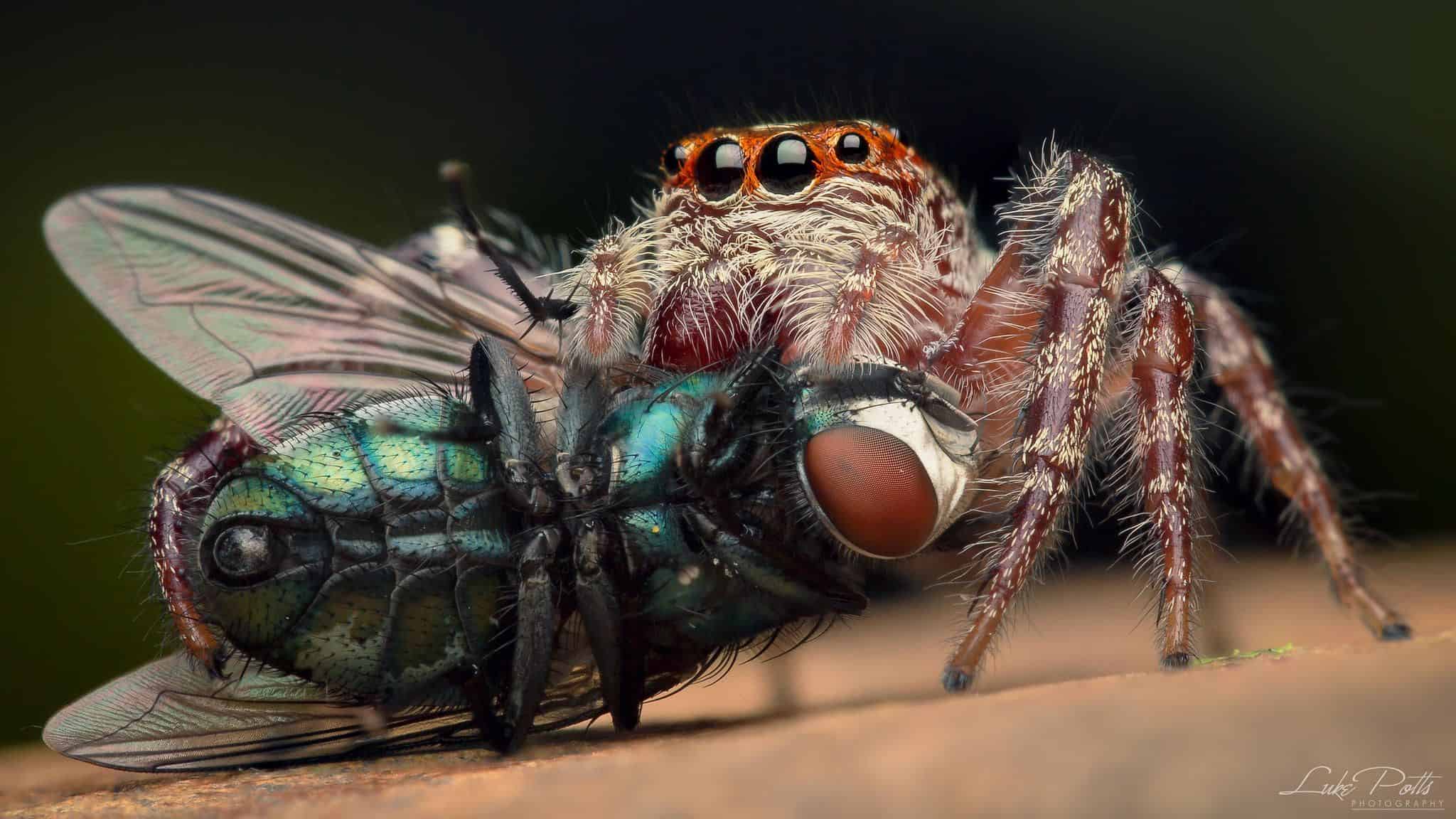
A spider cannot chew and swallow a fly the way you eat food. It bites the fly, injects venom, pours digestive enzymes into or onto it, and then sucks up the liquid that results, leaving a dry, crumpled husk. This is called external digestion, and it is how nearly every spider eats.

Step by Step: How a Spider Eats a Fly
- Catch. Web builders feel the fly’s struggles through vibrations in the silk. Hunting spiders, such as jumping spiders, stalk or ambush it.
- Bite and subdue. The spider bites with its fangs (the tips of its jaws, called chelicerae) and injects venom. For a fly, the venom works fast and the struggling usually stops within seconds.
- Wrap (some species). Many web builders spin silk around the fly. This keeps it from escaping and lets the spider save it for later.
- Add digestive fluid. The spider releases digestive enzymes into the fly through the bite wounds, or over the fly’s body. The enzymes break soft tissue down into a nutrient-rich soup.
- Crush and suck. The spider works the fly with its jaws, crushing and squeezing it, while a muscular sucking stomach draws the liquid in. Fine hairs around the mouth filter out solid bits, because a spider can only swallow liquid.
- Discard. What is left is the fly’s dry exoskeleton. Some spiders leave an intact empty shell; others leave a small chewed-up ball. Either way, it is usually dropped from the web.
Web Spiders vs. Hunting Spiders
All spiders digest outside their bodies, but they catch and handle a fly in different ways.
| Web-building spiders | Hunting spiders | |
|---|---|---|
| Examples | Orb weavers, cobweb spiders (common house spider), cellar spiders, funnel weavers | Jumping spiders, wolf spiders, crab spiders, sac spiders |
| How they find the fly | Feel vibrations in the web | Spot it by sight or touch, then stalk, chase or ambush |
| Silk wrapping | Common, especially in orb weavers and cobweb spiders | Rare; they hold prey with their legs and jaws |
| When they eat | Often right away, or later if the fly is wrapped and stored | Almost always straight away |
| Leftovers | Husk dropped from or cut out of the web | Husk left where they fed |
How Long Does It Take?
It depends on the spider and the size of the meal. A small fly can take anywhere from several minutes to an hour or more, and some spiders stop, rest and return to a wrapped meal later. Bigger prey takes longer.
Do Spiders Have Teeth?
Not like ours. Spiders have fangs for injecting venom, and many have small toothlike points on their jaws that help them grip and mash prey. They still cannot chew food into pieces and swallow it, which is why they turn it into a liquid first.
Is It Dangerous to Us?
The spiders you see eating flies in your home are almost always harmless to people. Their venom is built for insects. A small number of species worldwide, such as widow spiders and recluse spiders, can cause medically significant bites. If you are bitten and have spreading redness, worsening pain or any unusual symptoms, call your doctor or a poison control center.
What If I Want to Feed a Pet Spider?
Pet spiders eat the same way. You offer live prey and the spider does the rest. Our guides cover the details:
Remove any uneaten live prey after a day or so, since some insects can bother a resting or molting spider.
Spider and Fly FAQ
Does a spider eat the whole fly?
No. It drinks the liquefied insides and leaves the hard outer shell, wings and legs behind.
Do spiders eat dead flies?
Most do not. They find prey by movement, so a fly that is already dead usually goes untouched. Some spiders will feed on very fresh prey that stops moving in the web.
Why do spiders wrap flies in silk?
Wrapping keeps the fly from escaping or damaging the web and lets the spider store it to eat later.
How often does a spider need to eat a fly?
Not often. Many adult spiders do fine on a meal or two a week and can go weeks without food when prey is scarce.
Can a spider eat a fly bigger than itself?
Yes. Venom and silk let many spiders handle prey larger than their own bodies. Pet keepers still offer smaller prey to avoid injuries.
Bottom Line
A spider eats a fly by biting it, dissolving its insides with digestive enzymes and drinking the liquid. Web builders usually wrap the fly first; hunters grab it and feed right away. Either way, the spider never chews and swallows solid food, and what remains is an empty shell.