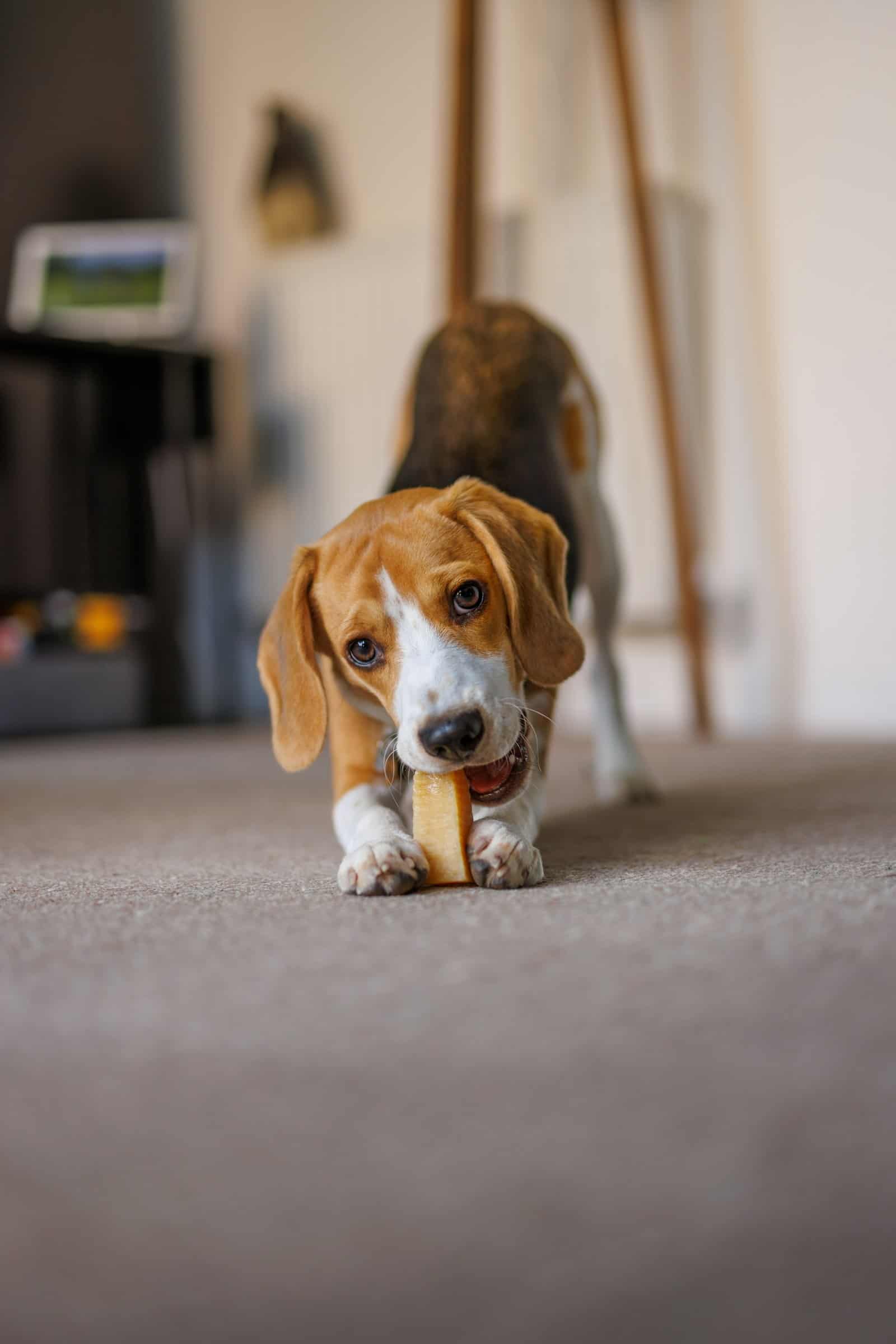
The best chew treat for your dog is one that is the right size, gives a little when you press it, is easy to digest, and fits into your dog’s daily calories. Just as important, it is one you give while you are there to watch. No chew is completely risk-free, so the goal is to pick the safest option for your dog’s size and chewing style.
Here is a simple way to choose, plus a look at the most common chew types and the ones vets say to skip.
Contents
A Quick Checklist
Not too hard. You should be able to dent it with your thumbnail.
Not too small. It should be too big to fit entirely inside your dog’s mouth.
Digestible. If a piece is swallowed, it should break down.
Calorie-counted. Chews are food, and some are surprisingly rich.
Supervised. Stay nearby and take the chew away when it gets small.
Step 1: Check the Hardness
Broken teeth are one of the most common chew injuries. Vets use two easy tests:
The thumbnail test. Press your thumbnail into the chew. If it does not leave a mark, the chew is too hard. Dr. Lori Teller of the Texas A&M College of Veterinary Medicine recommends this test for nylon toys, and it works for edible chews too.
The kneecap test. If you would not want to be hit on the knee with it, it is too hard for your dog’s teeth.
Antlers, hooves, real bones, and very hard nylon chews fail both tests.
Step 2: Pick the Right Size
Choose a chew that is longer than your dog’s muzzle and too large to swallow whole. When in doubt, go up a size. Once a chew is worn down small enough to swallow, take it away. That last piece is the one most likely to cause choking or a blockage.
Step 3: Count the Calories
VCA Animal Hospitals advises keeping treats to no more than 10% of a dog’s daily calories, and chews count toward that limit.
Some chews add up fast. A Tufts University study of bully sticks found 9 to 22 calories per inch. An average 6-inch stick had about 88 calories, which is roughly 30% of a 10-pound dog’s daily needs. For a small dog, that means a short session or a smaller chew, and a little less food at dinner.
Common Chew Treats Compared
Chew
Good points
Watch out for
Dental chews
Made to be chewed up and digested. Products with the VOHC seal have been shown to reduce plaque or tartar.
Calories. Follow the size guide on the pack.
Bully sticks
Single ingredient, digestible, and long-lasting for many dogs.
High in calories. The Tufts study also found bacteria on some sticks, so wash your hands after handling.
Rawhide
Widely available and inexpensive.
Large swallowed pieces can cause choking or blockages. If you use it, pick a well-made product and supervise closely.
Fish skins
Lighter and quicker to eat. A good fit for small dogs.
Do not last long. Strong smell.
Tripe and tendon chews
Single ingredient and very tasty to most dogs.
Rich, so introduce slowly. Can upset sensitive stomachs.
Yak cheese chews
Long-lasting and low odor.
Very hard. Many fail the thumbnail test, so they are a poor choice for heavy chewers.
Pig ears and pork skin
Most dogs love them.
High in fat. Pig ears have been linked to Salmonella, so handle them carefully.
Puppies: baby teeth are fragile. Stick to softer chews made for puppies, and ask your vet when to move up.
Power chewers: pick larger sizes and avoid anything brittle. Dogs that try to swallow chunks do better with a stuffed rubber toy than an edible chew.
Small dogs: watch calories closely and choose thin, short chews.
Seniors and dogs with dental disease: go softer, and ask your vet what is safe.
Dogs with food allergies or sensitive stomachs: choose single-ingredient chews and check the protein source.
Chew Time Safety
Stay in the room while your dog chews.
Keep sessions short at first, and offer fresh water.
In homes with more than one dog, separate them so no one gulps a chew to guard it.
Wash your hands after handling animal-based chews.
Throw away chews that are small, sharp, or slimy.
Call your vet right away if your dog is gagging, drooling heavily, vomiting, straining to pass stool, has a swollen belly, or seems to be in pain after a chew.
Bottom Line
Use the thumbnail test, size up, count the calories, and stay close while your dog chews. For most dogs, a VOHC-accepted dental chew or a digestible single-ingredient chew in the right size is a safer pick than bones, antlers, or hooves.
This article is for general information only and is not a substitute for veterinary advice. If your dog has dental problems, a sensitive stomach, or a history of swallowing things, ask your veterinarian which chews are safe.